Showing posts with label religion. Show all posts

Wednesday, July 11, 2018

MY Independence day

Last Wed was July 4th or Independence Day.  I didn't have time to write what I really wanted to write then, so I'm writing it now.

July 4th is commonly known as Independence Day, where Americans celebrate their independence from Great Britain.  But the week following July 4th is special to me as I think back to MY independence from a religion that controlled my life.

I was raised in the Jehovah's Witness religion, a separatist religion that believes they are the only ones with the TRUE religion.  One of their many unusual teachings is that being gay is a choice and a 'learned behavior'.  Sometime in my 20s I realized that this belief wasn't true.  I'd known I was gay since I was a kid but didn't know any other gay people, so from whom could I have 'learned' this?  

Once I understood the Jehovah's Witness religion was wrong about that teaching I became suspicious of many other teachings with which I was never comfortable, such as shunning.  JWs are taught to shun those who leave the religion, even family members.  They claim they do this to protect the congregation from the sin of the one being shunned, but I always thought it seemed like emotional blackmail to require relatives to shun their family.

On Sat, July 3, 1993, 25 years ago, I met a man at a gay bar who would become my boyfriend. We spent the long, holiday weekend together and I decided then that I would not return to the JW church.

Even though I knew this decision would eventually result in being shunned by my family and friends.


The week following July 4th 25 years ago was glorious as I felt a new sense of freedom I'd never experienced before, and as I spent time with my new boyfriend.

And then came the gut-wrenching meeting with my family where I told them I was gay, I was leaving the JW religion, and that I understood I would be shunned and likely not see or hear from them again. They tried to talk me out of it but my mind was made up.  Everyone cried.

But as hard as it was to do that, I knew it was the right thing for me, and I felt a sense of relief after it was over.  I simply HAD to start becoming my authentic self.

So, 25 years ago, just after Independence Day, was MY independence day.

If interested, you can read my full coming out story here: part I, part II, part III, part IV, part V.

Wednesday, September 14, 2011

I do but you don't

I began reading this article with the intent of being satisfied that the number of people who favor same sex marriage is going up. After all its title is "Near Split in US Over Legal Gay Marriage".

And while I was encouraged that half the people polled are in favor of marriage equality, I was simultaneously disturbed by the hypocrisy of the mother who "thinks the world" of her daughter's same sex partner and believes they should have equal rights, but can't support marriage equality due to her religion.


The writer is kind, in my opinion, by suggesting that "its complicated" and that "Americans are grappling with it". Maybe I'm overly sensitive to religion-based hypocrisy because of my own family's estrangement, but really... how "complicated" is it? You either believe in equality and vote for it or you don't.

Some may feel like the mother in this article, that gays should have equal rights in everything except marriage. But that really wouldn't make them EQUAL, now would it? Getting the same rights through an alternative measure (not through marriage) inherently creates a separate class.

Some seem to think that same sex couples should simply move to a state that offers same sex marriage. Can you imagine how preposterous it would be if that were truly implemented? What if 10% of the US population moved to the 6 states and the District of Columbia where they can legally marry? Even more preposterous is the idea that such a suggestion might have been made to African Americans 50 years ago when they sought legal equality.

The other grossly overlooked piece of the puzzle is that same sex couples who are married in the 6 states plus the District of Columbia where same sex marriage is legal only receive equal STATE rights. They still do not get equal FEDERAL rights.

Yet somehow these well-meaning people like the mother in this article allow their religion to override their consideration and respect for their very own daughter and her partner. The mother concludes the article by saying “We had to bring them to the
house and hug them and love them and tell them these things and not let that keep us apart.”

In my opinion, this should keep her and her daughter apart. My parents and siblings chose their religious beliefs over their relationship with me and in a twisted way I'm glad they did. At least they aren't hypocrites. At least they don't "think the world" of me & Spouse in their home and then vote against our equality. My family's behavior is at least consistent with their speech.

It seems to me that some people want to act hypocritically and then excuse it or try to reduce its impact by saying "its complicated". Well, important decisions frequently are complicated but that does not mean we have any less responsibility to do the right thing. The true measure of one's character is how they act in "complicated" situations.

You can read the article here and feel free to share your thoughts with me by commenting on this post.

Tuesday, May 10, 2011

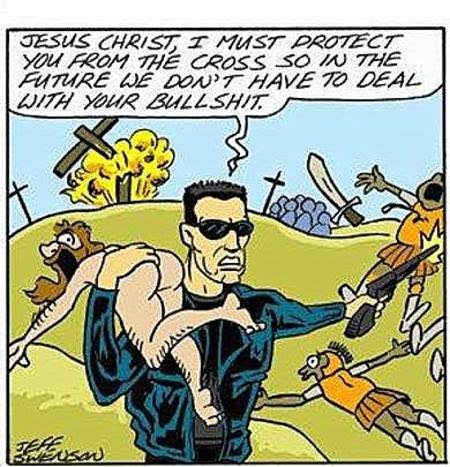
Religious humor

Hat tip to my friend Jared for these irreverent but funny religious pieces!


Tuesday, January 19, 2010

Pact with the Devil

By now everyone's heard about Pat Robertson's vile claim that Haiti's devastating earthquake is the result of it's pact with the Devil. Honestly, I can't understand how he could have ANY followers left after such a terribly insensitive (not to mention utterly ridiculous) comment.

Apparently the Devil is a reader of the Minneapolis Star-Tribune, and decided to use that newspaper to send a letter to Robertson. The letter read:

"Dear Pat Robertson,

I know that you know that all press is good press, so I appreciate the shout-out. And you make God look like a big mean bully who kicks people when they are down, so I'm all over that action.

But when you say that Haiti has made a pact with me, it is totally humiliating. I may be evil incarnate, but I'm no welcher. The way you put it, making a deal with me leaves folks desperate and impoverished.

Sure, in the afterlife, but when I strike bargains with people, they first get something here on earth -- glamour, beauty, talent, wealth, fame, glory, a golden fiddle. Those Haitians have nothing, and I mean nothing. And that was before the earthquake. Haven't you seen "Crossroads"? Or "Damn Yankees"?

If I had a thing going with Haiti, there'd be lots of banks, skyscrapers, SUVs, exclusive night clubs, Botox -- that kind of thing. An 80 percent poverty rate is so not my style. Nothing against it -- I'm just saying: Not how I roll.

You're doing great work, Pat, and I don't want to clip your wings -- just, come on, you're making me look bad. And not the good kind of bad. Keep blaming God. That's working. But leave me out of it, please. Or we may need to renegotiate your own contract.

Best, Satan"

Crush du Jour: Alessandro Nivola

Friday, July 31, 2009

Friday fragments

Being a car guy, I was intrigued by this car knowledge quiz. I was surprised I only got 15 out of 20 correct. I'm consoling myself by pointing out that many of the questions were brand-related. If you think you know a little something about car brands, take the quiz and tell me in the comments how many you got correct. My current dream car is the BMW 3 series retractable hardtop convertible.
This is car porn.

The other day I heard friends talking about books they're reading/had read and I realized its been over a year since I read a book. This made me feel badly about myself. My mind immediately flashed to me and Spouse sitting on the sofa watching (mostly mindless) TV every night instead of reading books. Really, how could I have stopped reading? Then it hit me: I read everyday! Not books, but blogs! I immediately felt better about myself.

Tony shared with me this interesting survey whose answers will tell you what religion most closely matches your beliefs. My top 4 were:
1. Mainline to Liberal Christian Protestants (100%)
2. Liberal Quakers (97%)
3. Unitarian Universalism (94%)
4. Secular Humanism (Atheism) (84%)

On Tues this week I went to the doctor about my shin. Now 3 days later, my ankle has begun to swell and turn colors like my shin. WTF?!?!?! Looks like I'll be going back to the doctor next week.

Wanna see Obama naked? Aren't those "interesting"?

Today is my (estranged) sister's 33rd wedding anniversay. Isn't that "interesting"?

Progress on the addition is coming along nicely. Look for my weekly addition update with photos tomorrow. Our entire house is filthy, now that much of the work has moved inside. Drywall was torn out, sending drywall dust into the air and all over the entire house. We'll spend some time this weekend vacuuming, dusting, and steam mopping the wood floors, even though it will all get dirty again next week. Hopefully it won't get as dirty next week, since all of the interior demo is done now, I think. (Crossing my fingers.)

On the social front, tonight is our regular Friday Night Dinner with 'the usual suspects. Tomorrow afternoon we're going to an anniversary party for our friends who've been together 15 years. Later that evening we're meeting some out-of-town friends for cocktails and then dinner. Should be fun!

Have a great weekend, y'all.

Crush du Jour: Preston Jones

Friday, April 17, 2009

Friday fragments

Condoms
Remember a few weeks ago when the Pope decided to go from being a religious leader to being a public health specialist? He said 'condoms worsen the AIDS epidemic'?? Well Patrick Boivin came up with a very clever, very funny response! The tag at the end reads "Don't be stupid. Use condoms." Perhaps subliminally, I read "Don't be stupid. Don't listen to the Pope." Don't you love creative people?

Winner
Speaking of creative, not to toot my own horn, but I won Kevin's "Caption This!" contest on his blog The Lisp. Don't believe me? Click here and see it for yourself.

Amazon scandal
Did you smell the big stink over Amazon.com's alleged removal of gay books from its rankings? Gay romance author Mark R. Probst noticed that days ago the sales rankings disappeared from two newly-released, high profile gay romance books on Amazon.com. The next day hundreds of GLBT books simultaneously lost their sales rankings, prompting many to wonder if Amazon was attempting to suppress the visibility of gay books. Probst learned that Amazon excludes “adult” material from appearing in some searches and best seller lists. Since these lists are generated using sales ranks, "adult" materials must also be excluded. Amazon.com responded that
it was a glitch and is fixing it. Life lesson: Don't mess with a queen's sh*t!!!

Adidas

Just in case you haven't seen the homo-erotic Adidas ad yet, click here. I have no idea what they're selling, but I'm pretty sure I need one.


Matt Alber
My friend John sent me this video, which I fell in love with! I'm not sure why, but it just speaks to me. I've never heard of the artist, Matt Alber. His voice reminds me of Rufus Wainright and his face (after the shave) reminds me of a very young Bruce Willis. Watch/listen to this video and try NOT to be affected.

Happy Friday, everyone!

Crush du Jour: Denis Ciplenkov

Thursday, January 22, 2009

Good old Al

I have always enjoyed listening to Al Sharpton because he voices a strong commitment to social justice, which appeals to me. He and Dennis Kucinich were the only two candidates for president who stood up for full marriage equality for GLBT folks.

Recently Sharpton called out the Mormon church (and others) for their silence on all social justice issues except removing marriage equality from GLBT folks in CA via Prop 8, and I couldn't agree with him more. Churches should spend their time, energy, and money fighting issues that actually harm people, like poverty and racism.

“It amazes me when I looked at California and saw churches that had nothing to say about police brutality, nothing to say when a young black boy was shot while he was wearing police handcuffs, nothing to say when the they overturned affirmative action, nothing to say when people were being delegated into poverty, yet they were organizing and mobilizing to stop consenting adults from choosing their life partners.”

“There is something immoral and sick about using all of that power to not end brutality and poverty, but to break into people’s bedrooms and claim that God sent you.”

“I am tired of seeing ministers who will preach homophobia by day, and then after they’re preaching, when the lights are off they go cruising for trade.”

“We know you’re not preaching the Bible, because if you were preaching the Bible we would have heard from you. We would have heard from you when people were starving in California, when they deregulated the economy and crashed Wall Street you had nothing to say. When [alleged Ponzi schemer Bernie] Madoff made off with the money, you had nothing to say. When Bush took us to war chasing weapons of mass destruction that weren’t there you had nothing to say. But all of a sudden when Proposition 8 came out you had so much to say, but since you stepped in the rain, we gonna step in the rain with you.”

(Quotes are from this article in Southern Voice)

Crush du Jour: Alex Marte

Friday, January 16, 2009

Friday fragments

Man, it is COLD outside! I probably shouldn't complain about our 10 degrees here in southern DE, when some of you are dealing with temps below zero. But living near the ocean means we have breezes and wind all the time, so although the thermometer may read 10 degrees, it feels closer to zero.
Poor Jordan is missing her walks. We've simply been taking her out in the yard to do her business, and then making her come back inside. We love our dog, but we are not about to freeze our asses off so she can enjoy sniffing the (frozen) neighborhood.

'Out' gay bishop Gene Robinson will kickoff Obama's inaugural events on Sunday by delivering an invocation on the steps of the Lincoln Memorial.
The HRC is pleased, but some have wondered if Robinson's selection was really a move to quiet the noisy gays who were angry over Obama's selection of minister and Prop 8 supporter Rick Warren. Obama's spokesperson says Robinson had already been selected when Warren's participation was announced. Read the story here.

Tonight, as usual, we have dinner with 'the usual suspects'. I'm pleased so many have said they are coming, despite the cold weather.

Tomorrow's MLK Jr. parade is still going to take place, despite the cold weather. Big Ella and I have signed up to be in the parade. Thank goodness she's got a good, strong heater!
Spouse said he was not interested in riding with me in the parade (he didn't ride with me in the 4th of July 'Doo Dah' parade either, you may recall) so I asked my terrific neighbor Claudia and she said yes. It should be fun.

My friend Chuck sent me this link to Prop 8 maps. Within most cities you can see the name and occupation of Prop 8 contributors and the amount of their donation. Hmm, interesting. Now why would Mrs. Kathryn Carter in Salt Lake City who is a 'homemaker' (ie: not gainfully employed) contribute $9,500 to stop a bill in CA? I can understand $100. But $9,500.??? Is it me, or does anyone else find this just a tad bit suspicious?

Not much planned for this long weekend. I hope that's not a mistake.

Crush du Jour: Diego Valentino

Wednesday, January 07, 2009

Religion and gays


IN THE LIFE DEBUTS ITS JANUARY SHOW “TIES THAT BIND”A LOOK AT THE INTERSECTIONS OF RELIGION AND SEXUALITY IN THE LGBT COMMUNITY

NEW YORK—IN THE LIFE, the only three-time Emmy nominated public television series documenting the gay experience, explores religious devotion and discord in the LGBT community.

The power of religion to shape our lives, our worldview and our political convictions transcends all cultures, faiths, and sexual orientations. The Bible, the Koran, and the Torah are tools for spiritual guidance, comfort, and direction, but many gay and lesbian people endure a sense of alienation from religious communities that fail to see a place for them in their congregations. In the wake of many defeats sustained by the LGBT community on Election Day, with the historic passage of Proposition 8 in California and similar amendments in other states, the entire country has been witness to how religion is used as a wedge in the larger community.

Believing that homosexuals have no place in the Christian Church, ex-gay ministries like EXODUS International promise gay and lesbian people struggling to live within the margins of religious fundamentalism "freedom from homosexuality through the power of Jesus Christ.”

In its lead-story, “In God We Trusted,” this episode of IN THE LIFE examines evangelical ex-gay ministries that have been established around the country to “re-program” LGBT people into heterosexuals -- often with tragic consequences endured by its members: guilt, desperation, even suicide.

In “A Conversation With…” Bishop Gene Robinson, the first openly gay Bishop ordained by the Episcopal Church, and Rabbi Sharon Kleinbaum, spiritual leader of New York City’s largest LGBT synagogue, map their spiritual journeys, noting parallels and pivotal moments that lead them to call for a more inclusive theology that celebrates people of all faiths and sexual orientations. “I wanted to be a part of a Judaism that could ask questions in a sophisticated way about the meaning of life, interfaith relations, sexuality, feminism, gender issues," says Kleinbaum, "and I believed that Judaism was actually big enough and strong enough, and that God was sophisticated enough to handle those kinds of questions.”

The episode concludes with a “Real to Reel” highlighting Parvez Sharma’s groundbreaking film, “A Jihad for Love.” This rare portrait of a different kind of “Jihad,” meaning: an inner struggle or to strive in the path of God, brings the stories of gay and lesbian Muslims across twelve countries to the forefront of the debate on Muslim scripture and homosexuality.

"Ties That Bind" has begun airing on American Public Television stations, and is available for free video streaming and downloadable podcasting from the IN THE LIFE website. To find out when it will be airing in their local areas, to stream or download it, viewers should go to here.

About In The Life Media
In The Life Media provides information about the lesbian, gay, bisexual, and transgender communities, documents the ongoing LGBT civil rights movement, and produces diverse images of the LGBT community to create better understanding and acceptance.

About IN THE LIFE
Produced by In The Life Media, IN THE LIFE is the longest running television show documenting the gay experience. IN THE LIFE is a three-time Emmy Award nominee, a Lambda Legal Liberty Award honoree, and the recipient of the Courage Award from the New York City Gay and Lesbian Anti-Violence Project. In 2004, GLAAD honored our organization with the prestigious Barbara Gittings Award "for contributions to LGBT media." In 2006, it won the Seigenthaler Award from the National Lesbian and Gay Journalists Association for "excellence in network television."

Crush du Jour: Scott Caan

Saturday, December 20, 2008

Bad move, Obama!

Gay leaders furious with Obama

Barack Obama’s choice of a prominent evangelical minister to deliver the invocation at his inauguration is a conciliatory gesture toward social conservatives who opposed him in November, but it is drawing fierce challenges from a gay rights movement that — in the wake of a gay marriage ban in California — is looking for a fight.

Rick Warren, the senior pastor of Saddleback Church in Southern California, opposes abortion rights but has taken more liberal stances on the government's role in fighting poverty, and backed away from other evangelicals’ staunch support for economic conservatism. But it’s his support for the California constitutional amendment to ban same-sex marriage that drew the most heated criticism from Democrats Wednesday.

“Your invitation to Reverend Rick Warren to deliver the invocation at your inauguration is a genuine blow to LGBT Americans,” the president of Human Rights Campaign, Joe Solomonese, wrote to Obama Wednesday. “[W]e feel a deep level of disrespect when one of architects and promoters of an anti-gay agenda is given the prominence and the pulpit of your historic nomination.

The rapid, angry reaction from a range of gay activists comes as the gay rights movement looks for an opportunity to flex its political muscle. Last summer gay groups complained, but were rebuffed by Obama, when an “ex-gay” singer led Obama’s rallies in South Carolina. And many were shocked last month when voters approved the California ban.

“There is a lot of energy and there’s a lot of anger and I think people are wanting to direct it somewhere,” Solomonese told Politico. The selection of Warren to preside at the inauguration is not a surprise move, but it is a mirror image of President Bill Clinton’s early struggles with gay rights issues. Obama has worked, and at times succeeded, to bridge the gap between Democrats and evangelical Christians, who form a solid section of the Republican base. Obama opposes same-sex marriage, but also opposed the California constitutional amendment Warren backed. In selecting Warren, he is choosing to reach out to conservatives on a hot-button social issue, at the cost of antagonizing gay voters who overwhelmingly supported him.

Clinton, by contrast, drew early praise from gay rights activists by pressing to allow openly gay soldiers to serve, only to retreat into the “don’t ask, don’t tell” compromise that pleased few.
The reaction Wednesday in gay rights circles was universally negative. “It’s a huge mistake,” said California gay rights activist Rick Jacobs, who chairs the state’s Courage Campaign. “He’s really the wrong person to lead the president into office.

Can you imagine if he had a man of God doing the invocation who had deliberately said that Jews are not going to be saved and therefore should be excluded from what’s going on in America? People would be up in arms,” he said.

The editor of the Washington Blade, Kevin Naff, called the choice “Obama’s first big mistake.”

“His presence on the inauguration stand is a slap in the faces of the millions of GLBT voters who so enthusiastically supported him,” Naff wrote, referring to gay, lesbian, bisexual and transgendered people. “This tone-deafness to our concerns must not be tolerated. We have just endured eight years of endless assaults on our dignity and equality from a president beholden to bigoted conservative Christians. The election was supposed to have ended that era. It appears otherwise.”

Other liberal groups chimed in. “Rick Warren gets plenty of attention through his books and media appearances. He doesn’t need or deserve this position of honor,” said the president of People for the American Way, Kathryn Kolbert, who described Warren as “someone who has in recent weeks actively promoted legalized discrimination and denigrated the lives and relationships of millions of Americans.”

Warren’s spokeswoman did not respond to a message seeking comment, but he has tried to blend personal tolerance with doctrinal disapproval of homosexuality. “I have many gay friends. I’ve eaten dinner in gay homes. No church has probably done more for people with AIDS than Saddleback Church,” he said in a recent interview with BeliefNet. In the same interview, he compared the “redefiniton of a marrige” to include gay marriage to legitimizing incest, child abuse, and polygamy.

Obama’s move may deepen some apparent distance between him among gays and lesbians, one of the very few core Democratic groups among whom his performance was worse than John Kerry’s in 2004. Exit polls suggested that John McCain won 27 percent of the gay vote in November, up four points from Bush’s 2004 tally - even as almost all other voters slid toward Obama.

But despite the symbolism of picking Warren, Obama is likely to shift several substantive policy areas in directions that will please gay voters and their political leaders, including a pledge to end “don’t ask, don’t tell” in military service. And some gay activists were holding out hope that they would either persuade Obama to dump Warren or Warren to change his mind.

Rick Warren did a real disservice to gay families in California and across the country by casually supporting our continued exclusion from marriage,” said the founder of the pro-same sex marriage Freedom to Marry, Evan Wolfson. “I hope in the spirit of the new era that’s dawning, he will open his heart and speak to all Americans about inclusion and our country’s commitment to equality.”
------------------

In a related note, The Associated Press reports that Obama's inauguration will feature a performance by singer Aretha Franklin. Let us all pray to the diety of one's choice that:
1. Obama changes his mind about having Warren give the invocation
2. Aretha wears a dress that covers her gigantic, saggy arms


Crush du Jour: Xavier Samuel

Saturday, December 13, 2008

The Bible and gay marriage

This is a REALLY good article about marriage that appeared in Newsweek. Its a bit long, but very well presented and definitely worth reading!

Our Mutual Joy
Let's try for a minute to take the religious conservatives at their word and define marriage as the Bible does.

Shall we look to Abraham, the great patriarch, who slept with his servant when he discovered his beloved wife Sarah was infertile? Or to Jacob, who fathered children with four different women (two sisters and their servants)? Abraham, Jacob, David, Solomon and the kings of Judah and Israel—all these fathers and heroes were polygamists.


The New Testament model of marriage is hardly better. Jesus himself was single and preached an indifference to earthly attachments—especially family. The apostle Paul (also single) regarded marriage as an act of last resort for those unable to contain their animal lust. "It is better to marry than to burn with passion," says the apostle, in one of the most lukewarm endorsements of a treasured institution ever uttered. Would any contemporary heterosexual married couple—who likely woke up on their wedding day harboring some optimistic and newfangled ideas about gender equality and romantic love—turn to the Bible as a how-to script? Of course not, yet the religious opponents of gay marriage would have it be so.


The battle over gay marriage has been waged for more than a decade, but within the last six months—since California legalized gay marriage and then, with a ballot initiative in November, amended its Constitution to prohibit it—the debate has grown into a full-scale war, with religious-rhetoric slinging to match. Not since 1860, when the country's pulpits were full of preachers pronouncing on slavery, pro and con, has one of our basic social (and economic) institutions been so subject to biblical scrutiny.


But whereas in the Civil War the traditionalists had their James Henley Thornwell—and the advocates for change, their Henry Ward Beecher—this time the sides are unevenly matched. All the religious rhetoric, it seems, has been on the side of the gay-marriage opponents, who use Scripture as the foundation for their objections.


The argument goes something like this statement, which the Rev. Richard A. Hunter, a United Methodist minister, gave to the Atlanta Journal-Constitution in June: "The Bible and Jesus define marriage as between one man and one woman. The church cannot condone or bless same-sex marriages because this stands in opposition to Scripture and our tradition."


To which there are two obvious responses: First, while the Bible and Jesus say many important things about love and family, neither explicitly defines marriage as between one man and one woman. And second, as the examples above illustrate, no sensible modern person wants marriage—theirs or anyone else's —to look in its particulars anything like what the Bible describes.


"Marriage" in America refers to two separate things, a religious institution and a civil one, though it is most often enacted as a messy conflation of the two. As a civil institution, marriage offers practical benefits to both partners: contractual rights having to do with taxes; insurance; the care and custody of children; visitation rights; and inheritance. As a religious institution, marriage offers something else: a commitment of both partners before God to love, honor and cherish each other—in sickness and in health, for richer and poorer—in accordance with God's will. In a religious marriage, two people promise to take care of each other, profoundly, the way they believe God cares for them. Biblical literalists will disagree, but the Bible is a living document, powerful for more than 2,000 years because its truths speak to us even as we change through history. In that light, Scripture gives us no good reason why gays and lesbians should not be (civilly and religiously) married—and a number of excellent reasons why they should.
In the Old Testament, the concept of family is fundamental, but examples of what social conservatives would call "the traditional family" are scarcely to be found. Marriage was critical to the passing along of tradition and history, as well as to maintaining the Jews' precious and fragile monotheism. But as the Barnard University Bible scholar Alan Segal puts it, the arrangement was between "one man and as many women as he could pay for."


Social conservatives point to Adam and Eve as evidence for their one man, one woman argument—in particular, this verse from Genesis: "Therefore shall a man leave his mother and father, and shall cleave unto his wife, and they shall be one flesh." But as Segal says, if you believe that the Bible was written by men and not handed down in its leather bindings by God, then that verse was written by people for whom polygamy was the way of the world. (The fact that homosexual couples cannot procreate has also been raised as a biblical objection, for didn't God say, "Be fruitful and multiply"? But the Bible authors could never have imagined the brave new world of international adoption and assisted reproductive technology—and besides, heterosexuals who are infertile or past the age of reproducing get married all the time.)


Ozzie and Harriet are nowhere in the New Testament either. The biblical Jesus was—in spite of recent efforts of novelists to paint him otherwise—emphatically unmarried. He preached a radical kind of family, a caring community of believers, whose bond in God superseded all blood ties. Leave your families and follow me, Jesus says in the gospels. There will be no marriage in heaven, he says in Matthew. Jesus never mentions homosexuality, but he roundly condemns divorce (leaving a loophole in some cases for the husbands of unfaithful women).


The apostle Paul echoed the Christian Lord's lack of interest in matters of the flesh. For him, celibacy was the Christian ideal, but family stability was the best alternative. Marry if you must, he told his audiences, but do not get divorced. "To the married I give this command (not I, but the Lord): a wife must not separate from her husband." It probably goes without saying that the phrase "gay marriage" does not appear in the Bible at all.


If the bible doesn't give abundant examples of traditional marriage, then what are the gay-marriage opponents really exercised about? Well, homosexuality, of course—specifically sex between men. Sex between women has never, even in biblical times, raised as much ire. In its entry on "Homosexual Practices," the Anchor Bible Dictionary notes that nowhere in the Bible do its authors refer to sex between women, "possibly because it did not result in true physical 'union' (by male entry)." The Bible does condemn gay male sex in a handful of passages. Twice Leviticus refers to sex between men as "an abomination" (King James version), but these are throwaway lines in a peculiar text given over to codes for living in the ancient Jewish world, a text that devotes verse after verse to treatments for leprosy, cleanliness rituals for menstruating women and the correct way to sacrifice a goat—or a lamb or a turtle dove. Most of us no longer heed Leviticus on haircuts or blood sacrifices; our modern understanding of the world has surpassed its prescriptions. Why would we regard its condemnation of homosexuality with more seriousness than we regard its advice, which is far lengthier, on the best price to pay for a slave?


Paul was tough on homosexuality, though recently progressive scholars have argued that his condemnation of men who "were inflamed with lust for one another" (which he calls "a perversion") is really a critique of the worst kind of wickedness: self-delusion, violence, promiscuity and debauchery. In his book "The Arrogance of Nations," the scholar Neil Elliott argues that Paul is referring in this famous passage to the depravity of the Roman emperors, the craven habits of Nero and Caligula, a reference his audience would have grasped instantly. "Paul is not talking about what we call homosexuality at all," Elliott says. "He's talking about a certain group of people who have done everything in this list. We're not dealing with anything like gay love or gay marriage. We're talking about really, really violent people who meet their end and are judged by God." In any case, one might add, Paul argued more strenuously against divorce—and at least half of the Christians in America disregard that teaching.


Religious objections to gay marriage are rooted not in the Bible at all, then, but in custom and tradition (and, to talk turkey for a minute, a personal discomfort with gay sex that transcends theological argument). Common prayers and rituals reflect our common practice: the Episcopal Book of Common Prayer describes the participants in a marriage as "the man and the woman." But common practice changes—and for the better, as the Rev. Martin Luther King Jr. said, "The arc of history is long, but it bends toward justice." The Bible endorses slavery, a practice that Americans now universally consider shameful and barbaric. It recommends the death penalty for adulterers (and in Leviticus, for men who have sex with men, for that matter). It provides conceptual shelter for anti-Semites. A mature view of scriptural authority requires us, as we have in the past, to move beyond literalism.


The Bible was written for a world so unlike our own, it's impossible to apply its rules, at face value, to ours. Marriage, specifically, has evolved so as to be unrecognizable to the wives of Abraham and Jacob. Monogamy became the norm in the Christian world in the sixth century; husbands' frequent enjoyment of mistresses and prostitutes became taboo by the beginning of the 20th. (In the NEWSWEEK POLL, 55 percent of respondents said that married heterosexuals who have sex with someone other than their spouses are more morally objectionable than a gay couple in a committed sexual relationship.) By the mid-19th century, U.S. courts were siding with wives who were the victims of domestic violence, and by the 1970s most states had gotten rid of their "head and master" laws, which gave husbands the right to decide where a family would live and whether a wife would be able to take a job. Today's vision of marriage as a union of equal partners, joined in a relationship both romantic and pragmatic, is, by very recent standards, radical, says Stephanie Coontz, author of "Marriage, a History."


Religious wedding ceremonies have already changed to reflect new conceptions of marriage. Remember when we used to say "man and wife" instead of "husband and wife"? Remember when we stopped using the word "obey"? Even Miss Manners, the voice of tradition and reason, approved in 1997 of that change. "It seems," she wrote, "that dropping 'obey' was a sensible editing of a service that made assumptions about marriage that the society no longer holds."


We cannot look to the Bible as a marriage manual, but we can read it for universal truths as we struggle toward a more just future. The Bible offers inspiration and warning on the subjects of love, marriage, family and community. It speaks eloquently of the crucial role of families in a fair society and the risks we incur to ourselves and our children should we cease trying to bind ourselves together in loving pairs. Gay men like to point to the story of passionate King David and his friend Jonathan, with whom he was "one spirit" and whom he "loved as he loved himself." Conservatives say this is a story about a platonic friendship, but it is also a story about two men who stand up for each other in turbulent times, through violent war and the disapproval of a powerful parent. David rends his clothes at Jonathan's death and, in grieving, writes a song: I grieve for you, Jonathan my brother; You were very dear to me. Your love for me was wonderful, More wonderful than that of women. Here, the Bible praises enduring love between men. What Jonathan and David did or did not do in privacy is perhaps best left to history and our own imaginations.


In addition to its praise of friendship and its condemnation of divorce, the Bible gives many examples of marriages that defy convention yet benefit the greater community. The Torah discouraged the ancient Hebrews from marrying outside the tribe, yet Moses himself is married to a foreigner, Zipporah. Queen Esther is married to a non-Jew and, according to legend, saves the Jewish people. Rabbi Arthur Waskow, of the Shalom Center in Philadelphia, believes that Judaism thrives through diversity and inclusion. "I don't think Judaism should or ought to want to leave any portion of the human population outside the religious process," he says. "We should not want to leave [homosexuals] outside the sacred tent." The marriage of Joseph and Mary is also unorthodox (to say the least), a case of an unconventional arrangement accepted by society for the common good. The boy needed two human parents, after all.

In the Christian story, the message of acceptance for all is codified. Jesus reaches out to everyone, especially those on the margins, and brings the whole Christian community into his embrace. The Rev. James Martin, a Jesuit priest and author, cites the story of Jesus revealing himself to the woman at the well— no matter that she had five former husbands and a current boyfriend—as evidence of Christ's all-encompassing love.


The great Bible scholar Walter Brueggemann, emeritus professor at Columbia Theological Seminary, quotes the apostle Paul when he looks for biblical support of gay marriage: "There is neither Greek nor Jew, slave nor free, male nor female, for you are all one in Jesus Christ." The religious argument for gay marriage, he adds, "is not generally made with reference to particular texts, but with the general conviction that the Bible is bent toward inclusiveness." The practice of inclusion, even in defiance of social convention, the reaching out to outcasts, the emphasis on togetherness and community over and against chaos, depravity, indifference—all these biblical values argue for gay marriage.


If one is for racial equality and the common nature of humanity, then the values of stability, monogamy and family necessarily follow. Terry Davis is the pastor of First Presbyterian Church in Hartford, Conn., and has been presiding over "holy unions" since 1992. "I'm against promiscuity—love ought to be expressed in committed relationships, not through casual sex, and I think the church should recognize the validity of committed same-sex relationships," he says.


Still, very few Jewish or Christian denominations do officially endorse gay marriage, even in the states where it is legal. The practice varies by region, by church or synagogue, even by cleric. More progressive denominations—the United Church of Christ, for example—have agreed to support gay marriage. Other denominations and dioceses will do "holy union" or "blessing" ceremonies, but shy away from the word "marriage" because it is politically explosive.


So the frustrating, semantic question remains: should gay people be married in the same, sacramental sense that straight people are? I would argue that they should. If we are all God's children, made in his likeness and image, then to deny access to any sacrament based on sexuality is exactly the same thing as denying it based on skin color—and no serious (or even semiserious) person would argue that.


People get married "for their mutual joy," explains the Rev. Chloe Breyer, executive director of the Interfaith Center in New York, quoting the Episcopal marriage ceremony. That's what religious people do: care for each other in spite of difficulty, she adds. In marriage, couples grow closer to God: "Being with one another in community is how you love God. That's what marriage is about."


More basic than theology, though, is human need. We want, as Abraham did, to grow old surrounded by friends and family and to be buried at last peacefully among them. We want, as Jesus taught, to love one another for our own good—and, not to be too grandiose about it, for the good of the world. We want our children to grow up in stable homes. What happens in the bedroom, really, has nothing to do with any of this.


My friend the priest James Martin says his favorite Scripture relating to the question of homosexuality is Psalm 139, a song that praises the beauty and imperfection in all of us and that glorifies God's knowledge of our most secret selves: "I praise you because I am fearfully and wonderfully made." And then he adds that in his heart he believes that if Jesus were alive today, he would reach out especially to the gays and lesbians among us, for "Jesus does not want people to be lonely and sad." Let the priest's prayer be our own.


Crush du Jour: VJ Logan


Let's try for a minute to take the religious conservatives at their word and define marriage as the Bible does.


Shall we look to Abraham, the great patriarch, who slept with his servant when he discovered his beloved wife Sarah was infertile? Or to Jacob, who fathered children with four different women (two sisters and their servants)? Abraham, Jacob, David, Solomon and the kings of Judah and Israel—all these fathers and heroes were polygamists.


The New Testament model of marriage is hardly better. Jesus himself was single and preached an indifference to earthly attachments—especially family. The apostle Paul (also single) regarded marriage as an act of last resort for those unable to contain their animal lust. "It is better to marry than to burn with passion," says the apostle, in one of the most lukewarm endorsements of a treasured institution ever uttered. Would any contemporary heterosexual married couple—who likely woke up on their wedding day harboring some optimistic and newfangled ideas about gender equality and romantic love—turn to the Bible as a how-to script? Of course not, yet the religious opponents of gay marriage would have it be so.


The battle over gay marriage has been waged for more than a decade, but within the last six months—since California legalized gay marriage and then, with a ballot initiative in November, amended its Constitution to prohibit it—the debate has grown into a full-scale war, with religious-rhetoric slinging to match. Not since 1860, when the country's pulpits were full of preachers pronouncing on slavery, pro and con, has one of our basic social (and economic) institutions been so subject to biblical scrutiny.


But whereas in the Civil War the traditionalists had their James Henley Thornwell—and the advocates for change, their Henry Ward Beecher—this time the sides are unevenly matched. All the religious rhetoric, it seems, has been on the side of the gay-marriage opponents, who use Scripture as the foundation for their objections.


The argument goes something like this statement, which the Rev. Richard A. Hunter, a United Methodist minister, gave to the Atlanta Journal-Constitution in June: "The Bible and Jesus define marriage as between one man and one woman. The church cannot condone or bless same-sex marriages because this stands in opposition to Scripture and our tradition."


To which there are two obvious responses: First, while the Bible and Jesus say many important things about love and family, neither explicitly defines marriage as between one man and one woman. And second, as the examples above illustrate, no sensible modern person wants marriage—theirs or anyone else's —to look in its particulars anything like what the Bible describes.


"Marriage" in America refers to two separate things, a religious institution and a civil one, though it is most often enacted as a messy conflation of the two. As a civil institution, marriage offers practical benefits to both partners: contractual rights having to do with taxes; insurance; the care and custody of children; visitation rights; and inheritance. As a religious institution, marriage offers something else: a commitment of both partners before God to love, honor and cherish each other—in sickness and in health, for richer and poorer—in accordance with God's will. In a religious marriage, two people promise to take care of each other, profoundly, the way they believe God cares for them. Biblical literalists will disagree, but the Bible is a living document, powerful for more than 2,000 years because its truths speak to us even as we change through history. In that light, Scripture gives us no good reason why gays and lesbians should not be (civilly and religiously) married—and a number of excellent reasons why they should.


In the Old Testament, the concept of family is fundamental, but examples of what social conservatives would call "the traditional family" are scarcely to be found. Marriage was critical to the passing along of tradition and history, as well as to maintaining the Jews' precious and fragile monotheism. But as the Barnard University Bible scholar Alan Segal puts it, the arrangement was between "one man and as many women as he could pay for."


Social conservatives point to Adam and Eve as evidence for their one man, one woman argument—in particular, this verse from Genesis: "Therefore shall a man leave his mother and father, and shall cleave unto his wife, and they shall be one flesh." But as Segal says, if you believe that the Bible was written by men and not handed down in its leather bindings by God, then that verse was written by people for whom polygamy was the way of the world. (The fact that homosexual couples cannot procreate has also been raised as a biblical objection, for didn't God say, "Be fruitful and multiply"? But the Bible authors could never have imagined the brave new world of international adoption and assisted reproductive technology—and besides, heterosexuals who are infertile or past the age of reproducing get married all the time.)


Ozzie and Harriet are nowhere in the New Testament either. The biblical Jesus was—in spite of recent efforts of novelists to paint him otherwise—emphatically unmarried. He preached a radical kind of family, a caring community of believers, whose bond in God superseded all blood ties. Leave your families and follow me, Jesus says in the gospels. There will be no marriage in heaven, he says in Matthew. Jesus never mentions homosexuality, but he roundly condemns divorce (leaving a loophole in some cases for the husbands of unfaithful women).


The apostle Paul echoed the Christian Lord's lack of interest in matters of the flesh. For him, celibacy was the Christian ideal, but family stability was the best alternative. Marry if you must, he told his audiences, but do not get divorced. "To the married I give this command (not I, but the Lord): a wife must not separate from her husband." It probably goes without saying that the phrase "gay marriage" does not appear in the Bible at all.


If the bible doesn't give abundant examples of traditional marriage, then what are the gay-marriage opponents really exercised about? Well, homosexuality, of course—specifically sex between men. Sex between women has never, even in biblical times, raised as much ire. In its entry on "Homosexual Practices," the Anchor Bible Dictionary notes that nowhere in the Bible do its authors refer to sex between women, "possibly because it did not result in true physical 'union' (by male entry)." The Bible does condemn gay male sex in a handful of passages. Twice Leviticus refers to sex between men as "an abomination" (King James version), but these are throwaway lines in a peculiar text given over to codes for living in the ancient Jewish world, a text that devotes verse after verse to treatments for leprosy, cleanliness rituals for menstruating women and the correct way to sacrifice a goat—or a lamb or a turtle dove. Most of us no longer heed Leviticus on haircuts or blood sacrifices; our modern understanding of the world has surpassed its prescriptions. Why would we regard its condemnation of homosexuality with more seriousness than we regard its advice, which is far lengthier, on the best price to pay for a slave?


Paul was tough on homosexuality, though recently progressive scholars have argued that his condemnation of men who "were inflamed with lust for one another" (which he calls "a perversion") is really a critique of the worst kind of wickedness: self-delusion, violence, promiscuity and debauchery. In his book "The Arrogance of Nations," the scholar Neil Elliott argues that Paul is referring in this famous passage to the depravity of the Roman emperors, the craven habits of Nero and Caligula, a reference his audience would have grasped instantly. "Paul is not talking about what we call homosexuality at all," Elliott says. "He's talking about a certain group of people who have done everything in this list. We're not dealing with anything like gay love or gay marriage. We're talking about really, really violent people who meet their end and are judged by God." In any case, one might add, Paul argued more strenuously against divorce—and at least half of the Christians in America disregard that teaching.


Religious objections to gay marriage are rooted not in the Bible at all, then, but in custom and tradition (and, to talk turkey for a minute, a personal discomfort with gay sex that transcends theological argument). Common prayers and rituals reflect our common practice: the Episcopal Book of Common Prayer describes the participants in a marriage as "the man and the woman." But common practice changes—and for the better, as the Rev. Martin Luther King Jr. said, "The arc of history is long, but it bends toward justice." The Bible endorses slavery, a practice that Americans now universally consider shameful and barbaric. It recommends the death penalty for adulterers (and in Leviticus, for men who have sex with men, for that matter). It provides conceptual shelter for anti-Semites. A mature view of scriptural authority requires us, as we have in the past, to move beyond literalism. The Bible was written for a world so unlike our own, it's impossible to apply its rules, at face value, to ours.
placeAd2(commercialNode,'bigbox',false,'')
dcmaxversion = 9
dcminversion = 9
Do
On Error Resume Next
plugin = (IsObject(CreateObject("ShockwaveFlash.ShockwaveFlash." & dcmaxversion & "")))
If plugin = true Then Exit Do
dcmaxversion = dcmaxversion - 1
Loop While dcmaxversion >= dcminversion

Marriage, specifically, has evolved so as to be unrecognizable to the wives of Abraham and Jacob. Monogamy became the norm in the Christian world in the sixth century; husbands' frequent enjoyment of mistresses and prostitutes became taboo by the beginning of the 20th. (In the NEWSWEEK POLL, 55 percent of respondents said that married heterosexuals who have sex with someone other than their spouses are more morally objectionable than a gay couple in a committed sexual relationship.) By the mid-19th century, U.S. courts were siding with wives who were the victims of domestic violence, and by the 1970s most states had gotten rid of their "head and master" laws, which gave husbands the right to decide where a family would live and whether a wife would be able to take a job. Today's vision of marriage as a union of equal partners, joined in a relationship both romantic and pragmatic, is, by very recent standards, radical, says Stephanie Coontz, author of "Marriage, a History."
Religious wedding ceremonies have already changed to reflect new conceptions of marriage. Remember when we used to say "man and wife" instead of "husband and wife"? Remember when we stopped using the word "obey"? Even Miss Manners, the voice of tradition and reason, approved in 1997 of that change. "It seems," she wrote, "that dropping 'obey' was a sensible editing of a service that made assumptions about marriage that the society no longer holds."
We cannot look to the Bible as a marriage manual, but we can read it for universal truths as we struggle toward a more just future. The Bible offers inspiration and warning on the subjects of love, marriage, family and community. It speaks eloquently of the crucial role of families in a fair society and the risks we incur to ourselves and our children should we cease trying to bind ourselves together in loving pairs. Gay men like to point to the story of passionate King David and his friend Jonathan, with whom he was "one spirit" and whom he "loved as he loved himself." Conservatives say this is a story about a platonic friendship, but it is also a story about two men who stand up for each other in turbulent times, through violent war and the disapproval of a powerful parent. David rends his clothes at Jonathan's death and, in grieving, writes a song:
I grieve for you, Jonathan my brother;You were very dear to me.Your love for me was wonderful,More wonderful than that of women.
Here, the Bible praises enduring love between men. What Jonathan and David did or did not do in privacy is perhaps best left to history and our own imaginations.
In addition to its praise of friendship and its condemnation of divorce, the Bible gives many examples of marriages that defy convention yet benefit the greater community. The Torah discouraged the ancient Hebrews from marrying outside the tribe, yet Moses himself is married to a foreigner, Zipporah. Queen Esther is married to a non-Jew and, according to legend, saves the Jewish people. Rabbi Arthur Waskow, of the Shalom Center in Philadelphia, believes that Judaism thrives through diversity and inclusion. "I don't think Judaism should or ought to want to leave any portion of the human population outside the religious process," he says. "We should not want to leave [homosexuals] outside the sacred tent." The marriage of Joseph and Mary is also unorthodox (to say the least), a case of an unconventional arrangement accepted by society for the common good. The boy needed two human parents, after all.


In the Christian story, the message of acceptance for all is codified. Jesus reaches out to everyone, especially those on the margins, and brings the whole Christian community into his embrace. The Rev. James Martin, a Jesuit priest and author, cites the story of Jesus revealing himself to the woman at the well— no matter that she had five former husbands and a current boyfriend—as evidence of Christ's all-encompassing love. The great Bible scholar Walter Brueggemann, emeritus professor at Columbia Theological Seminary, quotes the apostle Paul when he looks for biblical support of gay marriage: "There is neither Greek nor Jew, slave nor free, male nor female, for you are all one in Jesus Christ." The religious argument for gay marriage, he adds, "is not generally made with reference to particular texts, but with the general conviction that the Bible is bent toward inclusiveness."
The practice of inclusion, even in defiance of social convention, the reaching out to outcasts, the emphasis on togetherness and community over and against chaos, depravity, indifference—all these biblical values argue for gay marriage. If one is for racial equality and the common nature of humanity, then the values of stability, monogamy and family necessarily follow. Terry Davis is the pastor of First Presbyterian Church in Hartford, Conn., and has been presiding over "holy unions" since 1992. "I'm against promiscuity—love ought to be expressed in committed relationships, not through casual sex, and I think the church should recognize the validity of committed same-sex relationships," he says.
Still, very few Jewish or Christian denominations do officially endorse gay marriage, even in the states where it is legal. The practice varies by region, by church or synagogue, even by cleric. More progressive denominations—the United Church of Christ, for example—have agreed to support gay marriage. Other denominations and dioceses will do "holy union" or "blessing" ceremonies, but shy away from the word "marriage" because it is politically explosive. So the frustrating, semantic question remains: should gay people be married in the same, sacramental sense that straight people are? I would argue that they should. If we are all God's children, made in his likeness and image, then to deny access to any sacrament based on sexuality is exactly the same thing as denying it based on skin color—and no serious (or even semiserious) person would argue that. People get married "for their mutual joy," explains the Rev. Chloe Breyer, executive director of the Interfaith Center in New York, quoting the Episcopal marriage ceremony. That's what religious people do: care for each other in spite of difficulty, she adds. In marriage, couples grow closer to God: "Being with one another in community is how you love God. That's what marriage is about."
placeAd2(commercialNode,'bigbox',false,'')

More basic than theology, though, is human need. We want, as Abraham did, to grow old surrounded by friends and family and to be buried at last peacefully among them. We want, as Jesus taught, to love one another for our own good—and, not to be too grandiose about it, for the good of the world. We want our children to grow up in stable homes. What happens in the bedroom, really, has nothing to do with any of this. My friend the priest James Martin says his favorite Scripture relating to the question of homosexuality is Psalm 139, a song that praises the beauty and imperfection in all of us and that glorifies God's knowledge of our most secret selves: "I praise you because I am fearfully and wonderfully made." And then he adds that in his heart he believes that if Jesus were alive today, he would reach out especially to the gays and lesbians among us, for "Jesus does not want people to be lonely and sad." Let the priest's prayer be our own.

Friday, December 12, 2008

Costco

My blog buddy cb wrote this funny yet poignant post regarding the use of Christmas and Christian references in the Corporate world. Please read it, as it will set the tone for this post.

My friend Wendy forwarded to me the following email from those narrow-minded neanderthals at the AFA:

"Please help us get this information into the hands of as many people as possible by forwarding it to your entire e-mail list of family and friends.
Costco says 'No' to Christmas...literally


December 2, 2008

Dear Friend,


Costco has 520 stores nationwide. But you will not find "Christmas" in a single store. That's because Costco says it will not use the term "Christmas" on its website or in its stores. Instead, Costco is telling customers it purposely chooses to use the generic "holiday" verbiage. You know, they stock holiday gifts, not Christmas gifts.

Last week, a customer wrote to Costco and asked this direct question – "Does Costco use the word 'Christmas' in your store advertising or on any signs anywhere in your stores during the Christmas season? That's a pretty simple question, yes or no."

Kory Rosacrans, staff manager for Costco replied, "I guess the answer would be No." Rosacrans said, "Costco does not advertise on television, on radio or in print like other retailers. We only advertise by mailings and e-mail messages sent directly to our members who have paid for the privilege of shopping with us."

Costco wants you to do your "Christmas" shopping with them, while refusing to recognize that Christmas even exists.

Send your e-mail to Costco. Let Costco know that you will exercise "your privilege" of shopping only at stores that recognize Christmas. Remind Costco that their competitors are vying for your business too, and you will shop accordingly.

Thank you for caring enough to get involved. If you feel our efforts are worthy of support, would you consider making a small tax-deductible contribution to help us continue?

Sincerely,
Donald E. Wildmon
Founder and Chairman
American Family Association"

Two observations:
1. Mr Wildmon inaccurately claims that "Costco refuses to recognize that Christmas even exists". The store is not denying the existence of Christmas, but rather, it simply uses a nondenominational term that doesn't exclude shoppers who may be Jewish, Buddhist, Muslim, and Atheist.
2. Notice how Mr Wildmon doesn't miss an opportunity to ask for a donation. Now, there's a businessman!


When you click on the link in AFA's email to send an email to Costco, the web form is prepopulated with the following text:
"Dear President Sinegal:


I was shocked by your company's response to a customer, saying Costco refuses to use the term "Christmas" in store advertising and promotions. I am shopping only at stores that do not ban Christmas in their stores and promotions.

Please count me as one who will NOT be shopping at Costco this "Christmas" season. And, I'm telling my friends about your company's decision."

However, the text is editable, so I changed it and sent this instead:
"Dear President Sinegal:


I was pleased with your company's decision not to use the term "Christmas" in store advertising and promotions. Since this America, where religious freedom is guaranteed, it is important to remember that Christians aren't the only ones shopping and celebrating. Christmas isn't the only holiday that occurs at this time of year, so I applaud Costco's decision to use nondenomination references instead.

Please pay no attention to those narrow-minded people who may claim they are "shopping only at stores that do not ban Christmas in their stores and promotions". Those people are ignorant and should be ignored.

Please count me as one who WILL be shopping at Costco this "holiday" season. And, I'm telling my friends about your company's decision. I write a blog that is read by approximately 1,500 people each week."

Now, I have nothing against Christians or Christmas. Some of my best friends and family are Christians who celebrate Christmas! But I do have something against people and groups like AFA who want to force their religion on everyone else. They get 'righteously indignant' that some retailers decide not to use the word Christmas. Their indignation would seem appropriate if a Christian church made this decision, but a retail chain?

Here's a little reminder for AFA all the rest of Americans: Churches are in the business of spreading religious ideology. Retailers are not. Retailers are in the business of selling stuff to people, regardless of their religious beliefs or non-belief. So don't get upset with a retailer for using language that is inclusive of all its shoppers.

I swear, things like this just make me want to slap some people.

Crush du Jour: Johann Urb